


Parashat Chag Pesach
03th April 2026
Week of 27 March- 04 April 2026
Torah portion : Ex. 13 :8 ; Haftarah : Dt. 16:1
My dear friends and readers, Shalom from Israel, where peace is awaited.
Understanding the Word of God, according to the teachings of the Church, especially after the Declaration Nostra Aetate, must involve listening to Israel, its tradition, and its interpretation. This attitude must be taken more seriously by Christians when it comes to understanding the New Testament. Since the message of the New Testament comes from within Judaism at the end of the Second Temple period, it is only by immersing ourselves in this universe that we will find the true meaning of the Christian faith, which is not extrinsic to Judaism, but intrinsic to it.
In this sense, living alongside the Jewish people, with their living tradition in the Land of Israel, makes the texts speak to the present day and in today’s language. It is as if the past were happening now, or as if the present were happening in the time that the texts describe.
As is well known, Israel is currently under intense pressure, and this is not a recent phenomenon. Indeed, since proclaiming its independence in 1948, its existence has been threatened. Throughout all these years, its existence has been denied by its neighbors, the Arab countries, and by many other countries around the world. The effort to defend and protect itself demands investments in knowledge, economic resources, and human resources; however, curiously, Israel has progressed steadily and, in many sectors, has reached the top positions in the world.
Paradoxically, despite the bombs that are launched intensely every day from the north to the south of the country, the celebration of Pesach occupies the central place in the life of every Jew in Israel: the cleaning of everything leavened, the preparation of food, the concern for being with family, and above all, reflecting on, discussing, and explaining the meaning of the celebration. What the Torah says is alive, it happens: “That you may remember the day you came out of the land of Egypt all the days of your life” (Dt. 16:3) – “And you shall tell your son on that day” (Ex. 13:8). In fact, one lives what the Pesach Haggadah says: “one should feel as if one were leaving Egypt today”. Existentially, for Israel the Pharaoh did not give up attacking; even after the people had already left, he still pursued them to exterminate them.
Israel experienced this in the past and today; the pharaohs did not disappear, but Israel simultaneously lives with the certainty that Pharaoh will not defeat it. The One and Unique God who freed it in the past continues to free it today. Therefore, the Pesach Seder that the Jewish people celebrate each year, and are celebrating now, is not an act of remembering the past, the story of the Exodus from Egypt, the departure from slavery to freedom, but a lived experience of the act being celebrated around the Seder table.
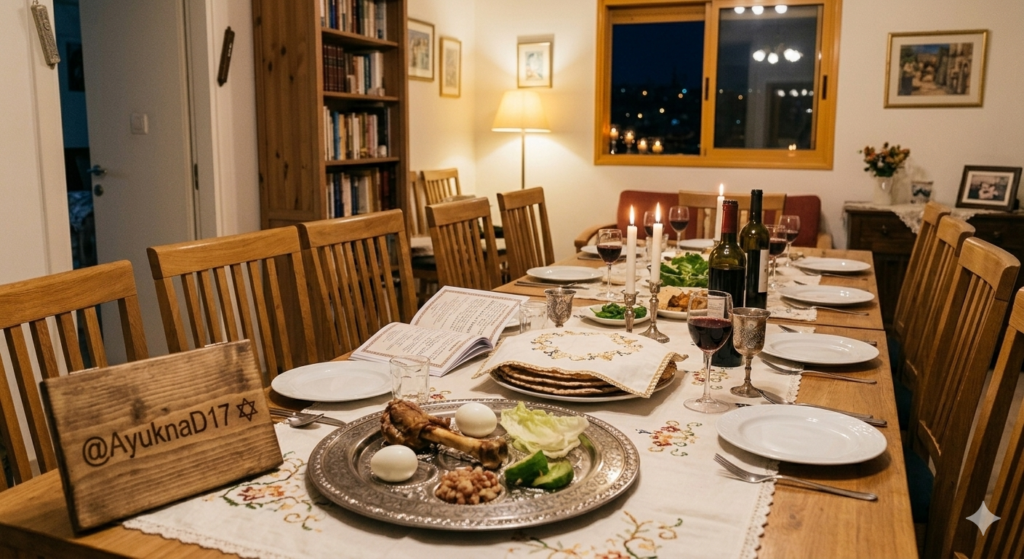
To give voice to the very text that the Jewish people experience this Seder night, I present a short excerpt from the Pesach Haggadah explaining the main points of the celebration:
“Rabbin Gamliel says:
Anyone who does not say these three things on Pesach – has not fulfilled his duty to say and explain the main points of the Hag Pesach,
and these are: Pesach, Matzah, and Maror.
– Pesach, which our ancestors ate while the Temple was still standing – for what reason?
Because the Holy One, blessed be He, passed over the houses of our ancestors in Egypt, as it is said: “And you will say, ‘It is the Passover sacrifice to the Lord, who passed over the houses of the children of Israel in Egypt when He struck Egypt, and He saved our houses, and the people bowed down and worshipped.'”
– This matzah that we eat – for what reason?
Because the dough of our ancestors did not have time to leaven, until the King of kings, the Holy One, blessed be He, appeared to them and redeemed them, as it is said: “And they baked unleavened cakes of the dough which they brought out of Egypt – for it was not leavened, because they were driven out of Egypt and could not tarry, and neither did they make a feast for them.”
– What is bitter that we eat?
Because the Egyptians made the lives of our ancestors, bitter in Egypt, as it is said: “And they made their lives bitter with hard labor, in mortar and in brick and in all work in the field, all their service in which they were made to serve with hardship”.
Pesach is also called the spring festival, because it falls in the month of Nisan, the spring month, as it is written: “Observe the month of Nisan and celebrate the Pesach to the Lord your God, for in the month of Nisan the Lord brought you out of Egypt by night (Dt. 16:1).
May that time of liberation and springtime for Israel come soon. Certainly, if Israel is at peace, free from threats, without Pharaohs, the whole world will benefit from peace, security, and good relations with one another.
שמח Hag Pesach Sameah !
This week’s Parasha Commentary was prepared by
Elio Passeto, NDS,Jerusalem–Israel, Director
[Copyright © 2026]
Comments are closed