


The Baptism of the Lord
11th January 2026
Lectionary Readings: Isaiah 42:1-4, 6-7; Psalm 29:1-2, 3-4, 3, 9-10; Acts 10:34-38; Matthew 3:13-17
Theme: Mission: A revelation of Jesus’ divine identity (Matthew 3:13-17)
The revelation of Jesus’ divine identity as God’s beloved Son; the start of His public mission; and the significance of baptism for believers, connects us to Christ’s new creation, our own spiritual rebirth, and our call to live as children of God in service and love, ending sin and bringing hope. It marks Jesus’s solidarity with humanity (even sinners) and the anointing by the Holy Spirit, inaugurating a new covenant by transforming water into a symbol of inner renewal. During early Christianity, the baptism of Jesus was celebrated as part of Epiphany (January 6th), a feast marking Christ’s manifestation to the world. This single Epiphany feast celebrated multiple events: the Magi’s visit, the wedding at Cana, and Jesus’ baptism by John. We can see the Development in the Eastern Church which focused on several childhood events, but Jesus’ baptism was central to its Epiphany, highlighting the “manifestation of God“. But we already know about the Separation in the West. Over time, Western traditions began to separate the baptism of Christ from the Epiphany, establishing it as a distinct feast. In the Catholic Church, it became the first Sunday after the Epiphany, concluding the Christmas season. The Feast of the Baptism of the Lord commemorates Jesus’ baptism by John the Baptist, marking the start of his public ministry and the manifestation of the Holy Trinity, evolving from its original inclusion within the broader Epiphany celebration in the early Church, eventually becoming a distinct feast in the West, celebrated on the Sunday after January 6th to conclude the Christmas season, emphasizing Jesus’ solidarity with humanity and mission.
The Feast of the Baptism of the Lord invites us to marvel at the depth of God’s love and the new beginning offered to all. Early Church Fathers saw in this moment not only Jesus’s identification with humanity, but also the revelation of the Trinity: Father, Son, and Holy Spirit (Hebrew: Ruah / Greek: pneuma) working together to bring salvation. As Jesus steps into the waters, he embraces our struggles and offers us a path to renewal. This feast reminds us that, through baptism, we are welcomed into God’s family and given a share in Christ’s mission. It’s a call to let go of past burdens and step forward with hope, trusting that God’s Spirit is at work within us. As we reflect on this sacred moment, may we be inspired to embrace our identity as beloved children of God and carry the light of Christ into the world with courage, compassion, and faith.
Before we go deeply into the message of this celebration, let us investigate more the connection between the readings for this Sunday. There is a connection between the first reading fromIsaiah 42:1-4, 6-7 CSB p1041, from the Hebrew Testament “Servant Songs,” which prophesies the mission and identity of Jesus, which is publicly revealed and confirmed at His Baptism, marking the start of His ministry as God’s chosen, gentle, and just Servant who brings light and liberation to all nations, fulfilling the Isaiah passage. The heavenly voice at the Baptism (Gospel) directly echoes Isaiah, declaring, “This is my beloved Son,” commissioning Him as the prophesied Servant. Also, there is a link to, Cf. Psalm 29’s CSB p746, whichdescribesthe majestic portrayal of God’s powerful voice over the waters with Jesus’ baptism, where God’s voice declares Him the Beloved Son, marking the start of His mission to bring peace and salvation, mirroring the Psalm’s themes of God’s sovereignty and the blessing of His people.
The “voice of the Lord” over the waters in the Psalm echoes the Father’s voice from heaven at the Jordan, identifying Jesus as the King who brings divine order and peace, while also calling believers to share in His divine sonship and mission through their own baptism. We also find how the second reading from, Cf. Acts 10:34-38 CSB p1545 (Peter’s sermon to Cornelius), shows this mission unfolding as God reveals it: He shows “no partiality:” accepting Gentiles and empowering them through the same Spirit that anointed Jesus, thus connecting Jesus’s baptism to the inclusion of all people in His saving work. Both readings highlight Jesus’ mission of “doing good and healing,” empowered by the Holy Spirit (Hebrew: Ruah / Greek: pneuma), which extends beyond Jewish boundaries to all nations. The Reading from the Gospel, Cf. Matthew 3:13–17 CSB p1340, describes Jesus’ baptism by John the Baptist. Jesus arrives at the site of John’s baptismal ministry somewhere along the Jordan River and shows solidarity with all humanity, especially with those who struggle. Filled with the Holy Spirit, he accepts his mission and invites us to do the same. We are challenged to renew our own commitment to serve others, to seek reconciliation, and to be instruments of peace in our communities.
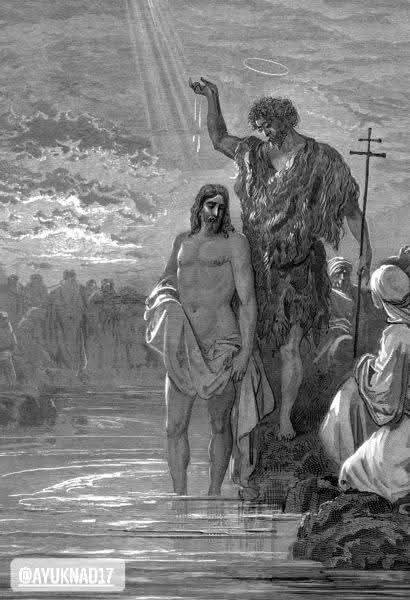
The baptism of Jesus, we can see in the gospels, took place on in the Jordan River and was administered by his cousin John the Baptist (Ibid. Matt. 3:13-17, Cf. Mark 1:9-11 CSB p1402, Cf. Luke 3:1-21 CSB p1442, and Cf. John 1:6-34 CSB p1487-1489) While Jesus was being baptized and praying, Luke says: “The heaven was opened, and the Holy Spirit descended upon him in bodily form like a dove. And a voice came from heaven, “You are my beloved Son; with you, I am well pleased”. We can see in this event that John the Baptist also offered baptism in the River Jordan to all those who wanted to obtain forgiveness of their sins and, in effect, the cleansing of their body and soul. In this narrative story we remember that John resists, but Jesus insists that His baptism is meant to fulfill all righteousness.
The Baptism of the Lord reveals Jesus as God’s beloved Son and marks the beginning of his public mission. For believers, this moment is not just historic, it’s a call to action. Baptism connects us to Christ’s new creation in reference to the account of Pentateuch, where we can read many instances and stories of God’s grace through water as in the creation story (Cf. Gen. 1:6-10 CSB p11-12), at the great flood (Cf. Gen. 6-9 CSB p12), the crossing the sea of Reeds (Cf. Exod. 14:19-31 CSB p100), the flowing of water and blood from the side of Jesus as he hung from the cross (Cf. John 19:34 CSB p1522). Those stories are inviting each of us into spiritual renewal and empowering us to live as children of God, committed to service and love. As we reflect on this event, let’s consider how we can put our faith into practice, ending sin in our own lives and bringing hope to others through concrete acts of kindness and justice. The Catechism of the Catholic Church (CCC) highlights Baptism as the foundation of Christian life, marking our own spiritual rebirth as children of God, and initiating Christ’s public ministry, all explained in Foundation of Christian Life CCC No’s 1213, 1265,1279,1213,1215 and 1216, which calls Baptism the gateway to life in the Spirit, freeing us from sin and incorporating us into the Church.
This feast underscores that our Baptism mirrors Jesus’ in the Jordan, making us members of Christ’s Body and sharers in His mission, as detailed in CCC sections on Baptism’s effects. In essence, the Feast of the Baptism of the Lord serves as a powerful annual reminder of the grace and identity we received at our own Baptism, drawing directly from the foundational teachings on Baptism found throughout the CCC. The last point that I want to offer is about the connection of this feast to the Compendium of the Social Doctrine of the Church (CSDC) which highlights Baptism as our initiation into Christ’s mission of love, justice, and service, making us missionaries for a new social order, and revealing our shared dignity as God’s beloved children, compelling us to care for all, especially the marginalized, thereby living out the CSDC’s call for an integral humanism and communion. Jesus’s baptism signifies God’s solidarity with sinners, empowering us to dismantle prejudice and build a just world, as taught in the CSDC.
The history of this feast reminds us that faith traditions can evolve, but their core meaning endures. Whether celebrated within Epiphany or as its own feast, the Baptism of the Lord concludes the Christmas season and marks the beginning of a new chapter. This is an opportunity to start afresh, embracing our identity as God’s children and actively participating in Christ’s mission. Let us take inspiration from this feast and set practical goals for spiritual growth, service, and compassion in the year ahead.
For Reflection and Discussion:
1. Are you ready for a call; and to reflect on and actively renew your own baptismal identity and mission? Do you remember and value your own baptism?
2. Are you living out your identity as a beloved child of God, and are you faithful to your baptismal promises?
Bibliography: Donald Senior, ET Al; The Catholic Study Bible 3rd Edition 2010; The New American Bible, Saint Joseph Edition 2011;The Catholic Prayer Bible 1993; Brown R.E; An Introduction to the New Testament 1997 p171-224;Liddell & Scott’s: Greek-English Lexicon 1889;Jean-Louis Ska: Translated by Sr. Pascale Dominique Introduction to Reading the Pentateuch, 2006 p19-25;Cathechism of the Catholic Church, United States of America copyright 1994, United States Catholic Conference, Inc. Libreria Editrice Vaticana;Compendium of The Social Doctrine of the Church: pontifical Council for Justice and Peace: Libreria Editrice Vaticana, Copyright 2004
This week’s Sunday Liturgy Commentary was prepared by
Dunhill Malunar Timkang, Jerusalem – Israel, Bat Kol Secretary
[Copyright © 2026]
Comments are closed